The Ultimate Guide to Exhibition Budgerigars: Breeding and Showing Professionally
Introduction
Exhibition Budgerigars, also known as “Show Budgies,” are a specific classification of Melopsittacus undulatus bred not for companionship, but to adhere to a precise “Standard of Perfection.” While they share an ancestry with the vibrant, petite pet birds found in homes worldwide, the true exhibition budgerigar is a masterpiece of selective breeding—a larger, powerfully built avian athlete. This article serves as the definitive guide for anyone seeking to understand what defines these remarkable birds and, crucially, how to start showing them professionally. This is a detailed, step-by-step advice on building a stud, conditioning, and joining the prestigious world of the professional show circuit.
What is an Exhibition Budgerigar?
The exhibition budgerigar is a testament to nearly two centuries of dedicated aviculture. It is a bird whose physical characteristics have been meticulously enhanced through generations of selective breeding to meet a complex standard defined by national and international organizations like The Budgerigar Society (UK), The American Budgerigar Society (US), or the World Budgerigar Organisation (WBO).
Distinguishing Features: The Ideal Standard
Unlike the wild-type budgerigar (which is green, yellow, and significantly smaller), or the varied pet mutations, a quality exhibition bird is judged on overall structural balance. The following features are paramount:
- Size and Substance: They are substantially larger and powerfully built, emphasizing a muscular, ‘stocky’ body structure.
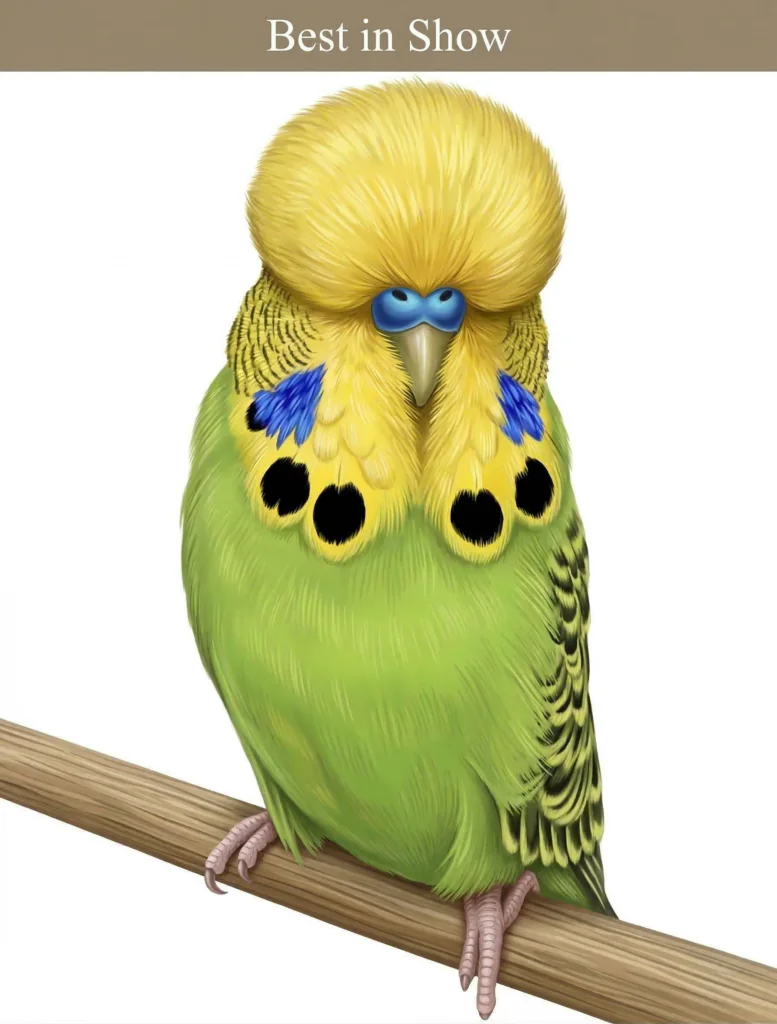
- The Head: This is perhaps the most defining feature. A top-tier exhibition bird must have a large, deep, and beautifully rounded head, which rises powerfully from the cere, showing no narrowness. The “brow” should be prominent, almost overhanging the eye.
- The Mask: A “deep” mask is essential. It must extend from the lower edge of the cere to the bottom throat spots, often appearing much wider than in pet birds.
- Throat Spots: Six or seven large, perfectly circular, black, and evenly spaced throat spots are required, which sit along the lower edge of the mask, creating a clean necklace.
- Stance: The bird must stand boldly at a specific 30-degree angle on its perch, displaying confidence and alertness. The tail should be straight and extend the bodyline perfectly, never “hinged” or drooping.
- Color and Variety: While visual markings are important (ensuring they match the specific mutation’s standard), the structure of the bird always takes precedence over color quality.
The Ideal Specimen
How to Start Showing Budgerigars Professionally
Starting a professional journey with exhibition budgerigars is not a casual undertaking. It requires passion, patience, considerable infrastructure, and, above all, strategic decision-making. If you aspire to move past the “Novice” class and breed future champions, follow this blueprint.
Step 1: Join a Budgerigar Society and Seek Mentorship
Your first professional step is not buying birds; it is joining an established society.
- The Budgerigar Society (UK/Country Specific): Join your national society and, crucially, a local club. The society provides closed, official leg rings (essential for showing owner-bred young birds) and puts you in touch with experienced members.
- The American Budgerigar Society (United States): The primary U.S. organization that connects you to local breeders, offers leg rings, and hosts club meetings.
- The Mentor: Aviculture is a “picked-brain” hobby. Seek out established breeders whose results you admire. Professional breeders are competitive but often extremely generous with knowledge and, eventually, quality stock.
Step 2: Establish Your Stud (The Foundation Stock)
A “stud” is not a collection; it is a family of related birds sharing specific positive genetic traits, carefully managed through pedigrees. To compete professionally, you must start with genetic substance, not just visual beauty.
- Selection Over Quantity: Professional success rarely comes from pet store birds or mixed collections. It’s far better to start with two or three pairs of high-quality stock, purchased directly from a recommended “word-of-mouth” breeder, than six pairs of mediocre birds.
- Buy a Bloodline: Buy birds from a breeder who has an outstanding stud with a contemporary, consistent “look.” You are not just buying a bird; you are investing in its ancestral background and predictability. Ask for pedigrees.
- Focus on Vitality and Features: The most successful studs select for “Vitality” above all else—robust health and fertility. From this foundation, they select to fix specific features (e.g., width of face, depth of mask). Professional breeders always prioritize the hen, as a quality breeding hen is “gold.” The cock often provides the major features.
The Professional Infrastructure
Step 3: Set Up a Professional Birdroom
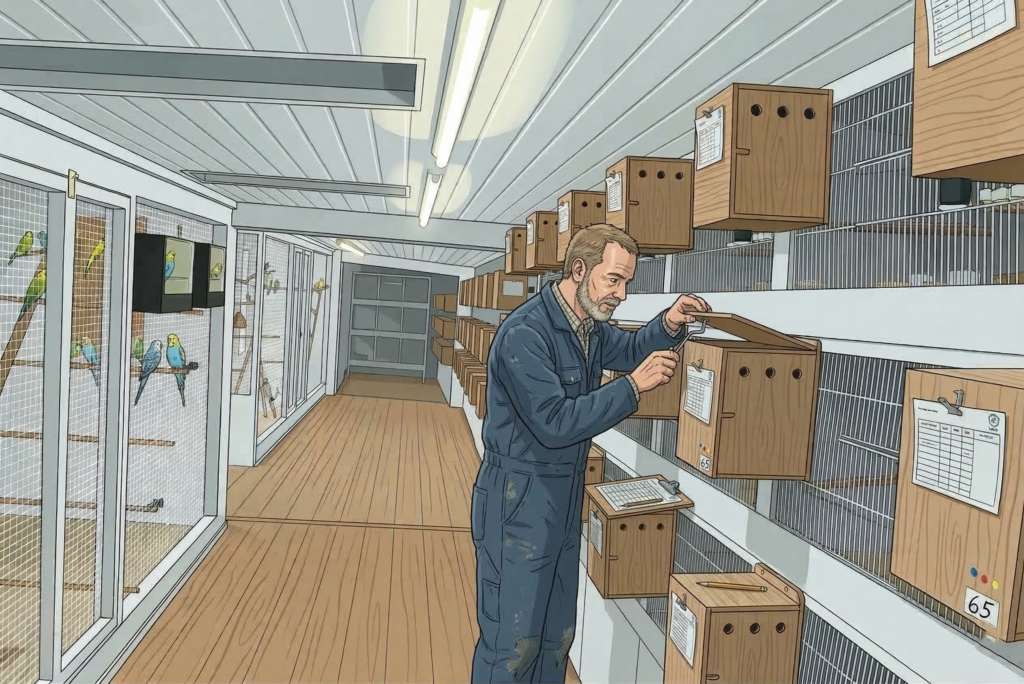
To breed show quality, you need a dedicated, climate-controlled environment.
- Breeding Cages: Professionals use standardized breeding cages (often wire-fronted, laminate-sided boxes, approximately 24x18x18 inches) for controlled pairing. This ensures you know the exact parents of every chick.
- Flight Aviary: Outside the breeding season, all birds need a large flight area (Image 1) to build the powerful muscle required for the perfect show stance.
- Controlled Environment: Insulation, ventilation, and lighting (including full-spectrum UV for health) are non-negotiable.
Step 4: Show Preparation, Conditioning, and Training
Your best-bred bird will not win if it is not prepared. Showing professionally is about presentation.
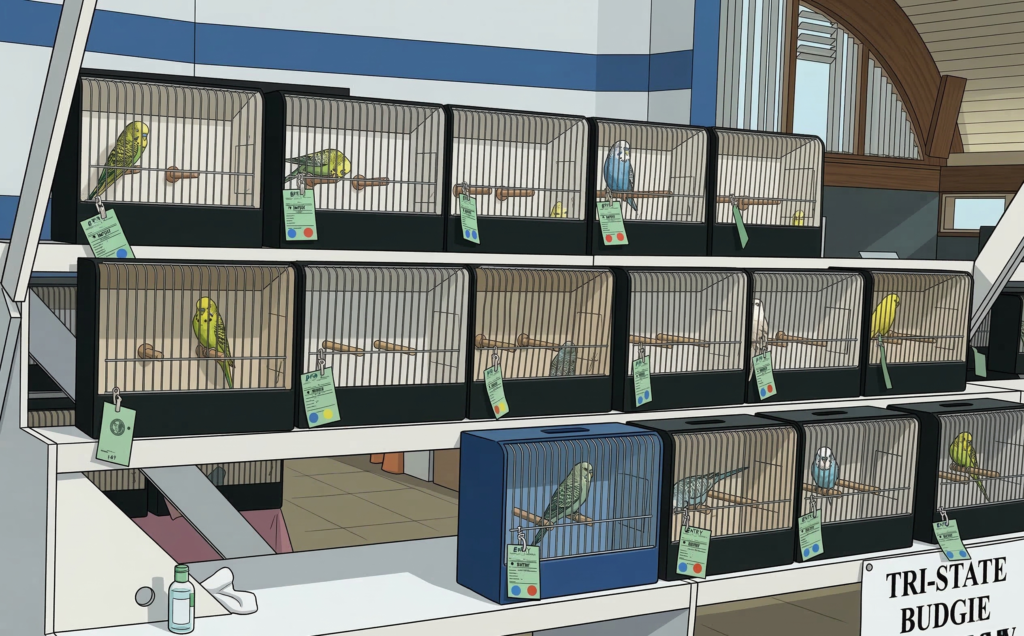
- Cage Training: The standard show cage is a very specific, small enclosure (approx. 14x12x6.5 inches) with specific white interiors and black exteriors. Your potential show birds must spend at least 4–6 weeks becoming calm and habituated to this cage.
- Conditioning: A budgerigar “in condition” is complete in feather, with natural bloom and vitality. Timing this condition with a major show requires expertise in diet and understanding molting cycles.
- Training (Perch Training): The judge will use a thin training stick to gently guide the bird to move between perches. A trained bird hops effortlessly; an untrained bird crashes in panic.
- Grooming: While diet creates shine, “spotting” is an accepted show practice. This involves plucking minor contour feathers around the six main throat spots to make them stand out.
Step 5: Understanding the Show Circuit and Hierarchy
Professional showing is structured to allow beginners to progress through clear statuses.
Professional Status Levels
- Junior: A separate section for exhibitors under a certain age (e.g., 16).
- Novice: This is the starting level for all adult newcomers. You will only compete against other Novices. Progress is usually governed by points won or time served.
- Intermediate: The bridge between Novice and Champion.
- Champion: The elite level. Progress to Champion status is achieved by winning major CCs or achieving specific, consistent show results.
Judgement and Rosettes
The show hall is a busy environment.
- Judging Process: Judges evaluate birds against the Ideal Standard. Birds are divided into Any Age (AA) or Young Bird (YB—those wearing the current year’s official closed ring).
- The Goal (CCs): The most coveted award is a Challenge Certificate (CC), awarded to the Best Adult Cock, Best Adult Hen, Best Young Cock, and Best Young Hen. Winning a CC contributes to a bird—and the owner—achieving Champion status.
- Best in Show (BIS): The overall winner of the entire exhibition.
The Competition Environment
Conclusion
Exhibition Budgerigars are not just a bird; they are an end-goal. Professional showing demands dedication, a strategic approach to breeding “the Ideal,” and a long-term commitment to the aviculture community. By joining a society, focusing on genetic substance rather than quantity, and mastering the complex art of show preparation and training, you can transition from an admirer to a competitor on the professional show circuit. Remember, every champion started with a single step—and a carefully selected breeding pair.