Taming the Feathery Fury: How to Identify and Fix Aggressive Budgie Behavior
Budgerigars, commonly known as budgies or parakeets, are generally celebrated as cheerful, gentle, and highly social companions. Their small size and bright personalities make them incredibly popular pets. However, sometimes new (and even experienced) owners are confronted with a confusing and distressing problem: an aggressive budgie.
If your previously sweet bird has started lunging, biting, or screeching when you approach, you aren’t alone. Aggression is rarely random, and it doesn’t mean your budgie is “bad.” However, It is usually a symptom of a correctable issue. This article will guide you through understanding why aggression happens and provide actionable steps to restore peace to your flock.
1. Recognizing the Signs of Budgie Aggression
It’s crucial to differentiate between normal visual communication and true aggression. Before you can address the behavior, you must understand what your budgie is telling you.
What Budgie Aggression Looks Like:
- Biting: This is the most obvious sign. A bite from an aggressive budgie is deliberate, often hard, and intended to hurt or warn you away. (This is different from gentle “beaking” or exploring).
- Lunging: The bird quickly extended its neck, beak open, toward your hand or face, often accompanied by a hiss.
- Charging: The budgie runs quickly toward you across a surface, ready to attack.
- Body Posture: An aggressive budgie will make itself look larger. It fluffs up its feathers (particularly on the head and neck), spreads its wings slightly away from its body, and may eye-pin (rapidly dilating and contracting its pupils).
- Vocalizations: Hissing or sharp, loud, repetitive screeching are common indicators of distress and anger.
2. Why is My Budgie Aggressive? Identifying the Cause
Once you recognize the behavior, the next step is to diagnose the underlying cause. Budgies rarely act aggressively without a reason. The motivation usually falls into one of four categories:
A. Fear and Lack of Trust
This is the most common cause of aggression in new budgies or those that have not been properly socialized. To a small prey animal, a large human hand is terrifying. If the hand keeps approaching despite the bird’s fear signals (like running away), the bird may resort to biting as a last-resort defense.
B. Territoriality
Budgies can become extremely protective of what they perceive as their “territory”—usually their cage or a favorite play gym. This is more common in females but occurs in both sexes. They view an invading hand as a threat to their resources or nesting site.
C. Hormones and Breeding Behavior
Seasonal changes, diet, and nesting opportunities can trigger surge hormones. However, if your budgie is female and nesting, or if your male is feeling highly frustrated, they can become uncharacteristically defensive and nippy. This is often a temporary cycle.
D. Pain or Illness
An overlooked cause of sudden behavioral changes is medical distress. If your calm budgie becomes aggressive overnight, or if the aggression is accompanied by other symptoms (lethargy, change in droppings, puffed-up feathers when resting), contact an avian veterinarian immediately.
3. The Step-by-Step Guide to Taming Aggressive Behavior
The key to taming aggression is consistency, patience, and a complete ban on punishment. Punishment (like yelling or tapping the beak) will never work and will only teach your bird that you are, indeed, a threat.
Follow this progression to rebuild trust:
Step 1: Manage the Environment First
Before interacting directly, ensure the environment isn’t fueling the aggression.
- The Right Cage: A small, cramped cage breeds frustration and territorialism. Provide the largest cage possible to allow for flight and exploration. (Find the right cage here)
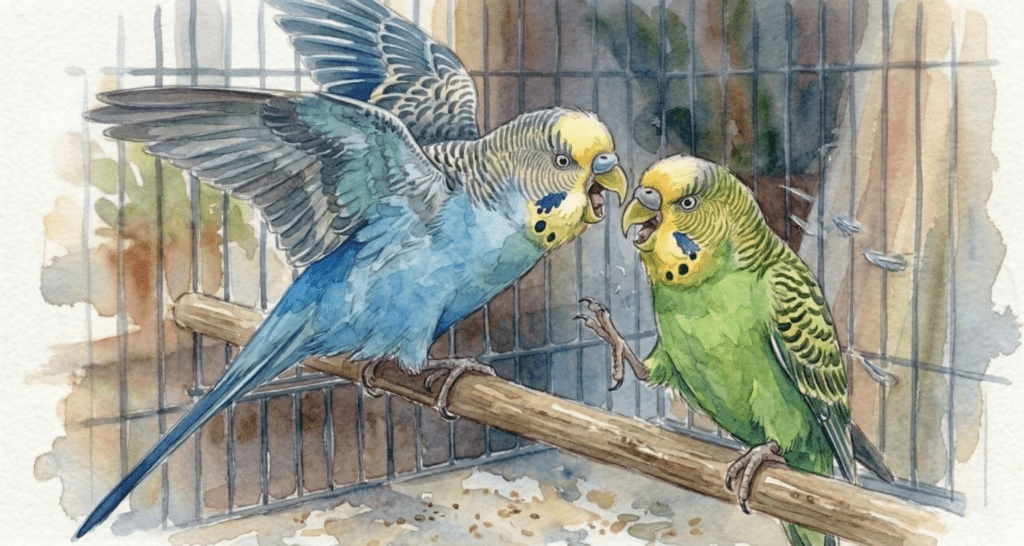
- Neutral Ground: Do not attempt to tame a territorial bird inside its cage. Image 1 shows that approaching the cage directly is a trigger for a territorial bird. For taming sessions, use a “neutral space” where the bird doesn’t feel the need to defend its nest—a different room or a standalone play gym.
Here, we see the classic problem: an aggressive reaction triggered by a hand approaching the bird’s perceived territory.
Illustration 1: The Initial Trigger
Step 2: Establish the Non-Threat (Desensitization)
If the cause is fear, you must desensitize the bird to your presence. This means teaching the budgie that your hand is not a predator.
- Passive Presence: Spend time near the closed cage without interacting. Read a book, work on a laptop, and talk softly to the bird.
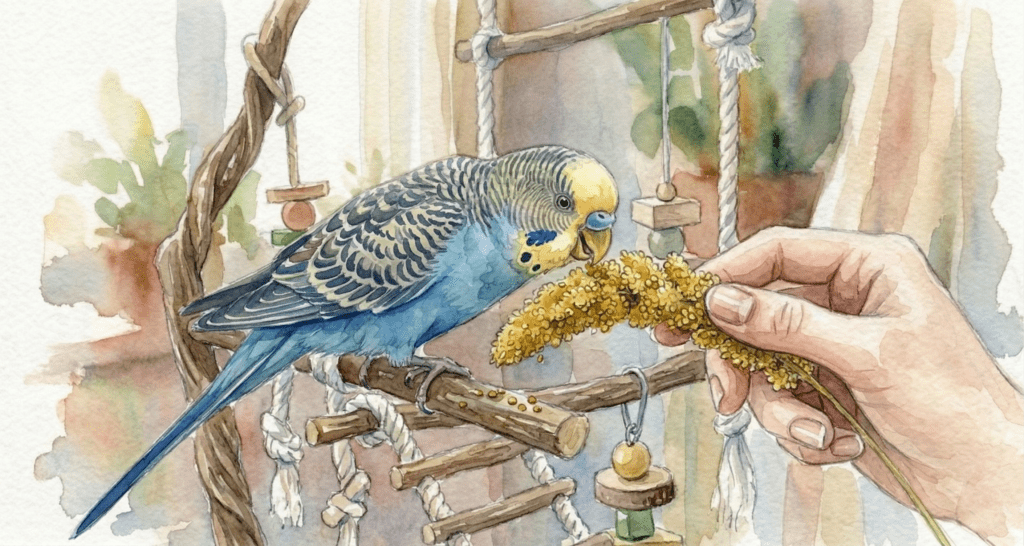
- The Millet Offer: Start by slowly offering a long spray of millet through the cage bars. Do not force the bird to come to you. Let it see that the hand produces things it likes.
Step 3: Transition to Safe Interaction (Outside the Cage)
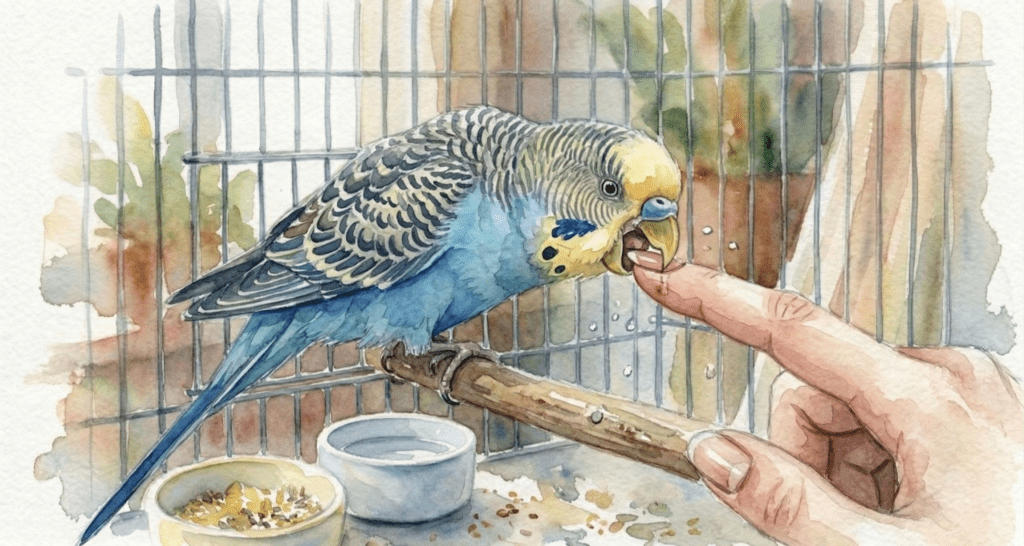
Once the bird accepts treats through the bars calmly, transition to interaction in that neutral space mentioned in Step 1. Your goal is to keep the interactions calm and rewarding, a distinct shift from the dramatic tension seen in Image 1.
The interaction must change fundamentally. We stop being the “invader” and become a source of positive things (millet) on a neutral perch, as shown below.
Illustration 2: Positive Associations Begin
Step 4: Building the “Step Up” Command
This is the cornerstone of budgie training. The goal is to get the bird to associate your finger with a reward (usually millet or a favorite seed).
- Introduce the Perch: Using the neutral wooden play gym from Image 2, offer your hand, palm flat, with the millet spray positioned so the budgie must step onto your index finger to reach the treat.
- Add the Cue: As the bird places weight on your finger, say “Step up” or “Up” clearly.
- Consistency is Key: Repeat this daily in short sessions (5–10 minutes) until the budgie steps onto your hand readily without seeing the treat first.
Reaping the Rewards: Full Trust and Integration
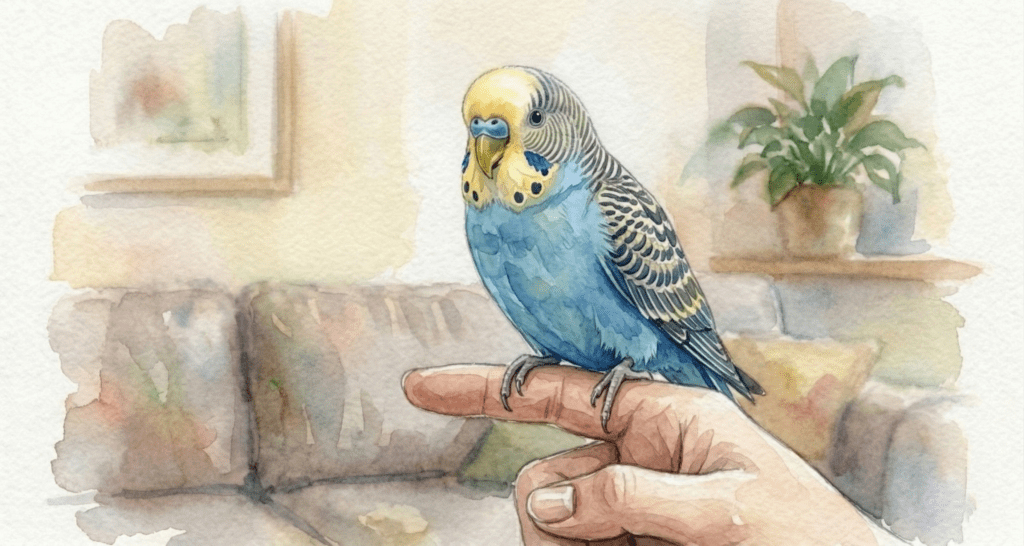
If you consistently apply these steps, your “feathery fury” will transform into a confident, bonded companion. Also, you will have moved beyond the cage-bound defense and the intermediate taming perch, achieving complete trust.
The final image shows the ultimate goal: the same bird from our previous examples, fully integrated into the home environment, now calm and bonded.
Illustration 3: Trust and Transformation Complete
A Note on Patience
Taming aggression is not an overnight process. Some budgies respond in weeks; others, particularly those with a long history of fear, may take months. However, the key is to celebrate small victories. When you respect your budgie’s boundaries and use positive reinforcement, you will create a strong, lasting bond built on trust, rather than fear